New England
Coastal New England offers a wildly different surfing experience than you’ll find anywhere else on the East Coast. North of New York, the topography changes dramatically, and so does the bathymetry. Peninsulas and rivermouths, coves and capes, points and fingers and offshore islands pepper the whole jagged, craggy, indented coastline, offering a dizzying assortment of pointbreaks and reefbreaks, rivermouths and slabs, even XL waves at offshore ledges.
The Waves

Ogunquit
The Ogunquit Rivermouth is the best-known break in Maine. The wave breaks off Lobster Point and produces long, workable rights and fast, inside lefts. The quality of the wave varies with swell direction and the shifting sand bottom -- it works well up to a few feet overhead, after which large waves tend to get mushy as they start cresting on the outer shoal. At that point, many of the locals head up to Kennebunkport. Slightly to the north of the rivermouth, the main beach provides plenty of peaks. It breaks through most any tide, except absolute high.

The Wall
When it comes to New Hampshire surf spots, The Wall is where everyone surfs when the points aren't breaking, which is most of the time. It's the only rideable spot when the surf is under three-feet, and it's always bigger than everywhere else around. However, at The Wall, bigger isn't always better. Often, it is just one solid, closed-out wall. On smaller days, this 2.5-mile stretch of sand is the best-shaped wave around. When the wind's cranking offshore, The Wall can offer sand-sucking barrels. Be mindful during high tides on smaller days as it will break close to the beach.

Cape Cod
Cape Cod is a 40-mile sandbar with wicked currents and pounding surf most of the year, save for the docile summer months. Such geology makes for constant change, thus the best break on any given swell may change with the tide, sandbar or any number of other subtle natural quirks. Luckily, 40 miles isn't too much to explore in a day, which is more often than not the time frame you're looking at for the golden end of a swell. Nevertheless, there always needs to be a beginning: The best place to start searching is at the Cape Cod National Seashore in Eastham and work north along the coast toward Wellfleet. Peaks in front of the parking lots are often the most crowded, while waves just as good go unridden farther down the beach.

Ruggles
"How do I get to Ruggles?" That's the first question asked upon entering Rhode Island. By handling the biggest hurricane surf on the East Coast, Ruggles has risen to mythical stature. Unfortunately, it's a rare bird. But even if it isn't triple-overhead, it's a beautiful place. Ruggles sits amid some of the most extravagant displays of money anywhere: the Newport Mansions built at the dawn of the 20th century by names like Astor and Rockefeller. From the beautiful stone Cliff Walk between the architectural wonders and the ocean, you get a view of it all.The beach at Ruggles, or more correctly, the cliff, faces east into the Rhode Island Sound. On solid south-to-southeast swells, particularly hurricane swells, ledging right-handers march around the corner and right into the natural arena. The wave itself isn't hollow but instead allows plenty of room for carving. A semi-gun, and sometimes even a full-fledged gun, is needed on serious swells, which is to say the only swells when Ruggles is really working anyway. Don't be fooled into thinking that just because you're on the East Coast, that this is a doable wave - if you don't have large-to-big wave experience, you're better off sitting in the grandstands and watching the show.
Point Judith
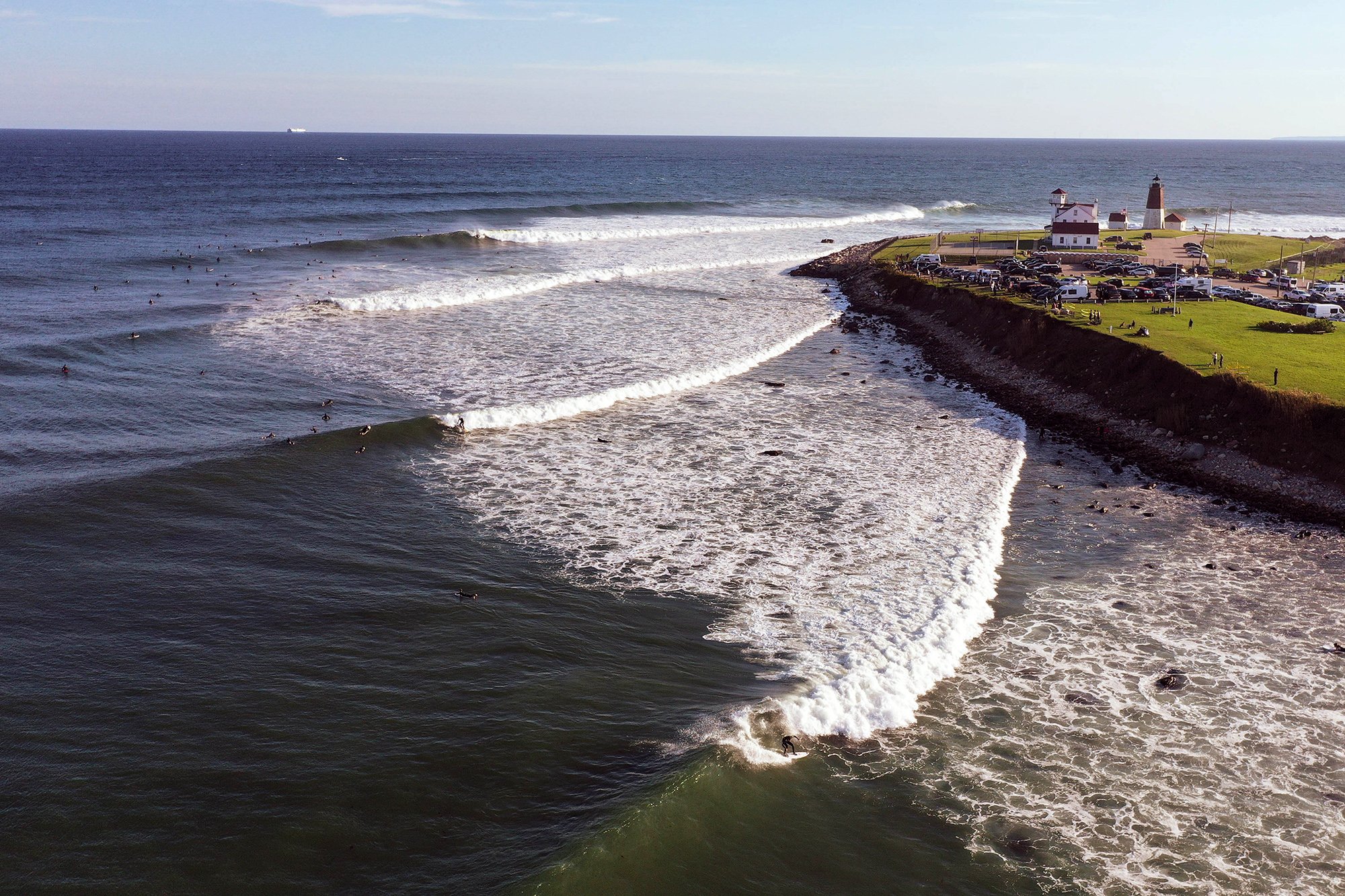
From a distance, Point Judith appears to be the ultimate East Coast pointbreak. It's not until you drive into the parking lot overlooking the break that you will see that Point Judith is actually a series of separate, distinct breaks -- sometimes connecting for a section or two, but most often not. Quickly, you realize this is not the J-Bay of the East. Access to the break involves climbing down to a rocky beach and negotiating a boulder-strewn lineup to reach the surf. The rocks are covered with black moss and are extremely slippery, especially when wet. Barnacles cover many of the rocks in the surf zone, and no channel exists for paddling. This won't be a problem in small-to-medium swells, but when the larger swells roll into town and across the reef at Judith, they come with strong currents and board-breaking power.The south side of the point has what has been referred to as a "death zone", located near a large breakwater where unfortunate (read unknowledgeable) surfers sometimes find themselves in a no-win situation of being pinned in a rocky corner by the current and surf. A good local hint is that the point, while well-exposed to the wind, can still be really fun and uncrowded on large, windblown, winter days. Though if you're looking for complete solitude, you might as well keep trekking on -- Point Judith is the main wave for most of the surfers living in Rhode Island's South County.

Matunuck
Matunuck’s surf is basically concentrated into three main breaks, from east to west: Deep Hole, a speedy left at low tide; Trestles, an A-frame peak with hollow rights and zippy lefts at lower tides; and The Point, a well-defined peak with a short, bowly right and a long, rippable left that links up with an inside bowl on incoming. All spots break over cobblestone/boulder reefs and can handle well-overhead swell. The Point likes SE swells, while Trestles and Deep Hole typically favor E swells, but all still operate on S swells.

There’s no place on Earth like New England, which covers a lot of territory. We have four distinct seasons, and each brings its own special beauty.
When to Score & Seasonal Surf Data
Know exactly when to score — powered by our expert historical forecast data.
Decades of spot-specific swell info — combined with forecaster insights — show your best chance to score, found only on Surfline.
Time to score

Forecaster reports
Seasonal Surf Data

New England, According to...
Ralph
Fatello
Legendary New Hampshire lensman/Surf Free Or Die creator expounds on one of the last frontiers of American surfing.
What makes New England a special destination for surfers?
There’s no place on Earth like New England, which covers a lot of territory: Rhode Island, Massachusetts, New Hampshire, Maine; technically Connecticut and Vermont are part of New England, but there’s little to no coastline. We have four distinct seasons, and each brings its own special beauty. If you really want to test your mettle, try surfing in New England during a snow-white winter, which bring unfriendly weather, biting-cold winds, deep snow drifts, freezing water, gnarly conditions, and some of our biggest, most challenging waves. Snow, sleet, ice and rain pelting you in the face like a firehose. Zero visibility for virtually blind takeoffs. Freezing hold-downs while numbness sets in. It’s not for the faint of heart, but if you want it, come and get it.
Once spring rolls around, the air temps ease up but the water temps remain chilly. Mother Nature awakens all the dormant vegetation, though, lighting it up with color. And the beach roses really come alive along the coastline. Combine those brilliant visuals with a crisp spring swell, and you have the makings of a truly memorable session. Summers are more hit-or-miss. Clearly, we suffer from the typical summer flat spells — although we might get an early tropical storm, and on rare occasions, a legit hurricane — but you’re really rolling the dice on getting decent surf. The water temps are warm, though — multiple days in July and August will be in the low 70’s, surfers will be wearing light rubber or even trunking it. However, we do get hit with the greenheads in July — nasty, relentless bugs that will bite you on the beach and in the water. I call them Satan’s Little Helpers. By August they’re gone, but then the mosquitoes and no-see-ums come to take their place.
But of all the seasons we get here in New England, fall is hands-down my all-time fave, and I think most of my fellow surf brethren would agree. The water temps are still favorable, the air temps are still plenty warm enough, the tourists have all packed up and left town, and it’s when we get some of our best surf. Besides that, the best thing about autumn is the breathtaking colors. If you’ve never experienced the stunning display of reds, yellows and oranges when the leaves change colors in New England, you owe it to yourself to witness it firsthand.
What kind of waves can visiting surfers expect?
We have it all in terms of what kinds of waves we get: beachbreaks that rival the sand-sucking barrels of Jersey and Hatteras; perfectly shaped reefbreaks that produce pitching A-frame peaks that’ll dazzle you for hours on the right tides; a slew of rivermouths where the outgoing river combined with a rising swell offers long rides at low-mid tides; and of course, our world-class pointbreaks — from wrapping, 150-yard-long lefts to hollow, winding and grinding rights, all of which unload on solid rocky bottoms chock full of nasty boulders that can hurt you and your boards. There are none of those soft, sandy-bottom points up here, but there’s all kinds of waves that will suit any preference.
What’s the vibe?
It’s positive overall, but it varies depending on your skill level, and more importantly, your manners. The vibe could be anything from lukewarm friendly, to in-your-face hot. So, if you paddle out at a new break that’s teeming with locals, be humble, be gracious, and work your way into the lineup. Don’t just paddle out and sit deeper than everyone else. That will not fly here. If you’re being a loud, aggro hotshot, New Englanders won’t mince words with you. They might, however, point your way to the beach. The local tribes vary from state to state. There are the older crews who’re set in their ways, then there’s the up-and-coming rippers, then there’s gaggles of beginners. But respect them, too, because those beginners could very well be related to the older locals, who won’t take any crap.
What should surfers bring?
Wetsuits. For winter, you need a 5/4mm with an attached hood at the minimum, some people even wear 6-mils, but you definitely want 7mm boots and gloves/mitts. Extremities are the first to go out here. For fall and spring, a 4/3mm hooded suit and 5mm boots and gloves is tolerable. For early summer and late fall, you’ll need a 3/2mm, no gloves, although there have been summer days when they were absolutely needed, so have a pair handy just in case. And wear your boots regardless because if there’s a real swell running and you’re out surfing the points, walking over the rocks is easier.
And if you forget anything, there are several great surf shops along the New England coastline, so you’re never too far from picking up a wetsuit, trunks, rashguard, clothes, wax, or a new board. You got Water Bros in Rhode Island. In Massachusetts there’s Levitate in Marshfield and Surfari in Gloucester. In New Hampshire there’s Zapstix in Seabrook and Cinnamon Rainbows in Hampton/North Hampton and Summer Sessions in Rye. And in Maine there’s Liquid Dreams in York and Ogunquit. All these shops have everything a traveling surfer could possibly need. No matter what you ride, they can accommodate you.
When is the best time to score?
The best time for solid surf is late summer to mid fall, which is peak hurricane season and also primetime for nor’easters. With active tropical systems still churning off the coast of Africa, plus those coveted nor’easters, plus our own little local swell makers, fall is absolutely the best time to visit New England. You can’t go wrong. If you come here in fall and score during a good swell, you will never forget it. It will stay with you. The colors, the waves, the people… It’s why I still live here. That New England charm is for real.
What else is there to do when you’re not surfing?
While I personally never liked golf, we have some of the prettiest golf courses in the country. There’s also great fishing, both freshwater and saltwater, and some beautiful bike trails, both mountain biking and road biking on paved surfaces. Just under an hour away there are mountains for hiking and whitewater rafting, and for those who enjoy dropping into cement bowls, there are lots of skateparks all over New England. Of course, there’s some world-class skiing and snowboarding opportunities in the winter, and at night, there’s plenty of music venues with both national and international acts, as well as some really talented local musicians covering every genre. It’s true, New England has it all.
What’s your favorite local cuisine?
There are several fine-dining restaurants throughout New England, along with many other affordable restaurants along the entire seacoast. We’re famous for our seafood, and there are dozens of restaurants that offer some of the freshest around, while on Boston’s North End, you’ll find some of the best Italian cuisine anywhere in the country. Flatbread Company and American Flatbread are located all throughout New England, Secret Spot in Hampton is a fave of local surfers for wraps, smoothies and acai bowls, and Seaglass in Salisbury is one of our all-time favorites — where you can sit right on the ocean and watch the waves peel off in front of you while you dine. The Old Salt in Hampton is another. You just can’t go wrong when it comes to dining around these parts.
Where can people learn to surf?
Most of the many surf shops in New England, and all those mentioned above, offer surf lessons and provide soft-tops and wetsuits. Just pick one and call them up. Certain individuals who will take on beginners, too, and there are guide services available for intermediate to advanced surfers.
What are some things people should be aware of when it comes to local culture and customs?
Oh, it’s like anywhere. We all have our little innuendos, and each local tribe has their own inside jokes and sayings. Just don’t have such thin skin around some of the more obvious locals. We have our accents, too. I don’t have that stereotypical Boston accent, but I can’t tell you how many times I’ve been looked at sideways when I open my mouth. Oh, and we love our professional sports teams. The Celtics, Bruins, Red Sox and Patriots rule, so if you come wearing a Yankees hat, you’re gonna raise a few eyebrows. Bottom line, though, is we’re all surfers. The customs are just part of our culture. If you surf, you speak our language.
Any other local tips?
Come here with a positive attitude, an open heart, a smile, and make friends with the locals. Don’t start off on the wrong foot by showing up with a ready-made crowd of a half-dozen surfers for your own packed lineup. Eat, shop and buy locally. Surf shops make their living selling to people like you, so visit them all and buy something from each one. Even if it’s a bar of wax. Compliment the locals — nothing over the top, just be cool and throw out a subtle hoot. Please be discreet when it comes to cameras, and whatever you do, don’t be blowing up special surf spots by posting them on social media. Nobody who lives here wants to see that. Finally, follow the golden rule: Give a wave, get a wave.
Travel Essentials
Culture & customs
Inherently stoic, puritanical and community-oriented, New Englanders can be rather tightlipped about what’s going on in their home zones. And since some of their very best spots only break a handful of times a year, locals tend to be very suspicious of surf media, surf industry, or outsiders with an agenda, so it’s best to keep your phones and cameras out of sight until you’re given the go-ahead from a respected loc’dog.
Local scene
Although the great Hawaiian Olympian, Duke Kahanamoku, first demo’d surfing in Rhode Island in 1924, New England surf culture didn’t really get rolling until the early 1960s with pioneers Steve Watson (Maine, 1960), Pete Laslow (New Hampshire, 1961), Bob Stevens (Massachusetts, 1963), and Chuck Fogerty and Matt Chrostowski (Rhode Island, 1960) planted their respective flags. Rhode Island surf culture evolved much faster (shops, contests, etc.) than the other states, while Maine’s remote northern reaches and outer islands remained largely uncharted until the 21st century. Despite enormous potential of exotic setups, local surfers have been able to maintain a certain level of anonymity, and while there are certainly plenty of talented surfers here, the number of New Englanders who’ve gone on to pro careers can be counted on one hand. On the other hand, New Englanders have been able to preserve the sanctity of their very best spots, which are rarely if ever documented.
What to bring
This is where the whole “winter warrior” term was conceived, so a minimum of two pairs of 5mm hooded fullsuits, booties and lobster claws are a necessity for any serious winter surfer, because hypothermia’s pretty much a given in the winter, the stage which you plummet dependent entirely on the equipment you choose. Only the most tightly sealed neoprene will do. One leak in your armor, and you’re done before you even begin. Any other time of the year, bring the 4/3. Better to have it and not need it…
How to get there
Fly into Boston Logan International Airport (BOS), rent a roomy vehicle for all your gear, and choose your own adventure. And by choose we mean pinpoint, and by adventure we mean state. Between the short swell windows, the jagged coastal geography and the unpredictable weather, navigating this coastline can be so frustrating, even the most dialed New England locals spend as much time finding waves than they do surfing them. Or they just stick to well-trodden old-faithfuls like Ruggles, Rye Rocks and Ogunquit Rivermouth. Befriend the right informant, though, and you could stumble upon the largest and heaviest surf possible on the Eastern Seaboard. On the opposite end of the spectrum, there’s hundreds of breaks that’ll take anyone.
Downtime
Eat a bowl of New England clam chowder and a fresh lobster roll. Go hiking or fishing, or better yet, spearfishing on the reefs. Rock out at a concert. Go see a game (but root for the right team). Thrash a skatepark. Go snowboarding in the mountains. Either way, you’re ripping in a winter wonderland.
Quick Tips
Travel Time
LAX: 5 hours, 25 minutes (3h, 52m layover)
Heathrow: 7 hours, 50 minutes
SYD: 21 hours, 12 minutes
Connectivity
Most of the New England coast has solid, reliable mobile phone coverage from providers, and WIFI is generally very accessible.
Currency
U.S. Dollar.
Avg. cost of...
Cup of coffee: $3.30 USD
Lunch: $17.50 USD
Beer: $5.50 USD
Hotel room: $175 USD
Visa Requirements
Visitors may require a visa, depending on their nationality and/or the purpose of their trip.
Drinking water quality
Generally fine across the region.
Hazards
Hypothermia. Slippery rocks. Monster sharks, especially in Massachusetts. Extreme tides, especially in Maine).
Cash, card, crypto
This is America, the world’s largest economy, so money talks. Most businesses accept major credit cards, some probably even take crypto. U.S. dollars are still a thing, too, and you’re never too far from an ATM.
Have feedback on this zone? Let us know [email protected]
Questions about booking with Surfline Travel? Check out our FAQs