Florida
Florida offers a distinctly exotic, polychromatic surfing experience. Despite being wonderfully gutted by jetties, piers and inlets, the state faces its share of meteorological and bathymetric challenges. The Bahamas block South Florida from receiving a lot of tropical juice; the rest of Florida’s low-lying Atlantic coast won’t hold long-period swells, short-period windswell can only get so good. However, given the right confluence of wind, swell, tide and sand placement, Florida waves can be profoundly fun, if not shockingly world-class. It’s pretty consistent, too — consistently small, but still — and it’s always warm.
The Waves

Jacksonville Beach Pier
Jax Pier is located in Jacksonville Beach several blocks north of Beach Blvd. and is the area’s high-tide break. Various peaks off the pier serve to spread everyone out a bit, which is good, since this is one of North Florida's most aggressive lineups. Jax Pier has lefts and rights and works on all swells and conditions.

Flagler Beach Pier
Heading south from St. Augustine, you'll pass Marineland before entering Frieda Zamba and Will Tant's home of Flagler Beach, a relaxed beach town with one true break, the Flagler Beach Pier. Crowds aren't too bad, and if you show some respect, you'll be welcome. Act like an idiot, get treated like an idiot. The break here changes with the seasons but is fairly easy to read when you pull up.

New Smyrna Inlet
New Smyrna Beach, on the south side of Ponce Inlet, is the most consistent surf break in Florida, if not the entire East Coast. When the whole world is flat, you can usually find a wave here. Furthermore, people flock to fill the miles of beach between the entrance and the Inlet — enough space that driving on the sand is not only necessary, it's encouraged. The water isn't any less clogged. While there's space to spread out, there's usually a surfer at every hole. NSB is best on NE to ENE swells with incoming tide; however, it works on most anything and can actually boost the size a bit. It may be one-foot along the beach, but right next to the Inlet it may be three times the size. At lower tides on bigger swells, waves often break on the far outside sandbar, called Shark Shallows.

Cocoa Beach Pier
Known previously as Canaveral Pier and now as Cocoa Beach Pier, this cradle of East Coast professional surfing made its name in the '60s and remains a longboard haven supported by the regular crew drawn to its long, crumbly lines in between the many surf contests that run here every year. Chances are you won't get barreled at Cocoa Beach Pier, since it's typically top-to-middle at best. However, like most of Cocoa Beach, the Pier remains a great place to score waves at high tide, when South Brevard's more critical breaks can doze for hours. More importantly, the Pier offers surfers the only wind shelter between Sebastian Inlet and Jetty Park. LINEUP TIPS: Etiquette | Surf Safety Basics

Sebastian Inlet
A long and storied history, Sebastian Inlet was first cut back in the early 1900’s with small coquina jetties. This inlet became the focal point in supporting a growing fishing industry and becoming a popular recreation area. The ebb and flow of sand up and the the coast occasionally closed off the inlet until 1948 when the current inlet was blasted open, creating the permanent opening we see today. While people do occasionally surf the south side of the Inlet, the north side is home to the jetty and all its glories, including the big-league spot, First Peak, and its slightly less-perfect but equally popular siblings Second Peak, Third Peak and OK Signs/Swimmers. Swells bounce off the jetty at First Peak with extra juice that can either max out the potential of a one-foot dribbler or add a few feet -- and one heck of a barrel -- to a head-high nugget. Second Peak, Third Peak and OK Signs don't benefit from the jetty's wedge, but are almost as fun. In fact, sometimes those peaks break even better, especially on NE swells.

Ft. Pierce Inlet
Continuing south from Vero, A1A takes you into St. Lucie County and Fort Pierce, an old cattle and citrus town. It's also home to Central Florida's final spot, the North Jetty, appropriately located in a rare piece of public land called Fort Pierce State Park. It's not hard to find, just drive south on A1A until the signs steer you west, then take a left into the park entrance less than a mile away. North Jetty is within Fort Pierce State Park. The State Park is a wildlife sanctuary and an entrance fee of is required. Unfortunately, the park doesn't open until 8 a.m., but you can buy an annual pass and they'll tell you the combination to the lock as it changes monthly. The pass will get you into Sebastian Inlet and every other state park freely as well.North Jetty is on the north side of the Fort Pierce Inlet and was one of the earliest spots to be surfed in Florida. A number of peaks break up and down the beach, and a good bowling right breaks up against the jetty. Good lefts break off the south side of the inlet on huge swells, but it's a very rare occurrence. The wave really lends itself to longboarding, not that there isn't a little hotdog potential with some swell.North Jetty is one of the first spots far enough north of the Bahamas island shadow to receive swells from the ESE. Even in the dead of summer, little peaks appear apparently out of nowhere. It's also one of the only spots in Florida that works best at high tide. As the tide comes in, the punchy little A-frame peaks improve. As the tide drops, rip currents really hurt the waves' form, and at low tide, the surf will drop to near flatness. Although a head-high swell can be very hollow, especially if the wind is out of the south or southwest, North Jetty is not a particularly big wave. However, it has excellent form. If the wind is too strong out of the north/northwest or hard onshore, look elsewhere. If the size is out of control, head south to Hutchinson Island or to Palm Beach.About the only time North Jetty isn't crowded is before 8 a.m. On weekends, after school and during business hours, it's a complete zoo. Weekdays aren't so bad, but there are certainly people on it. There are generally enough peaks to go around, but the local longboarders will always dominate several of the peaks. An eclectic bunch of rippers frequent the place as well.

Juno Pier
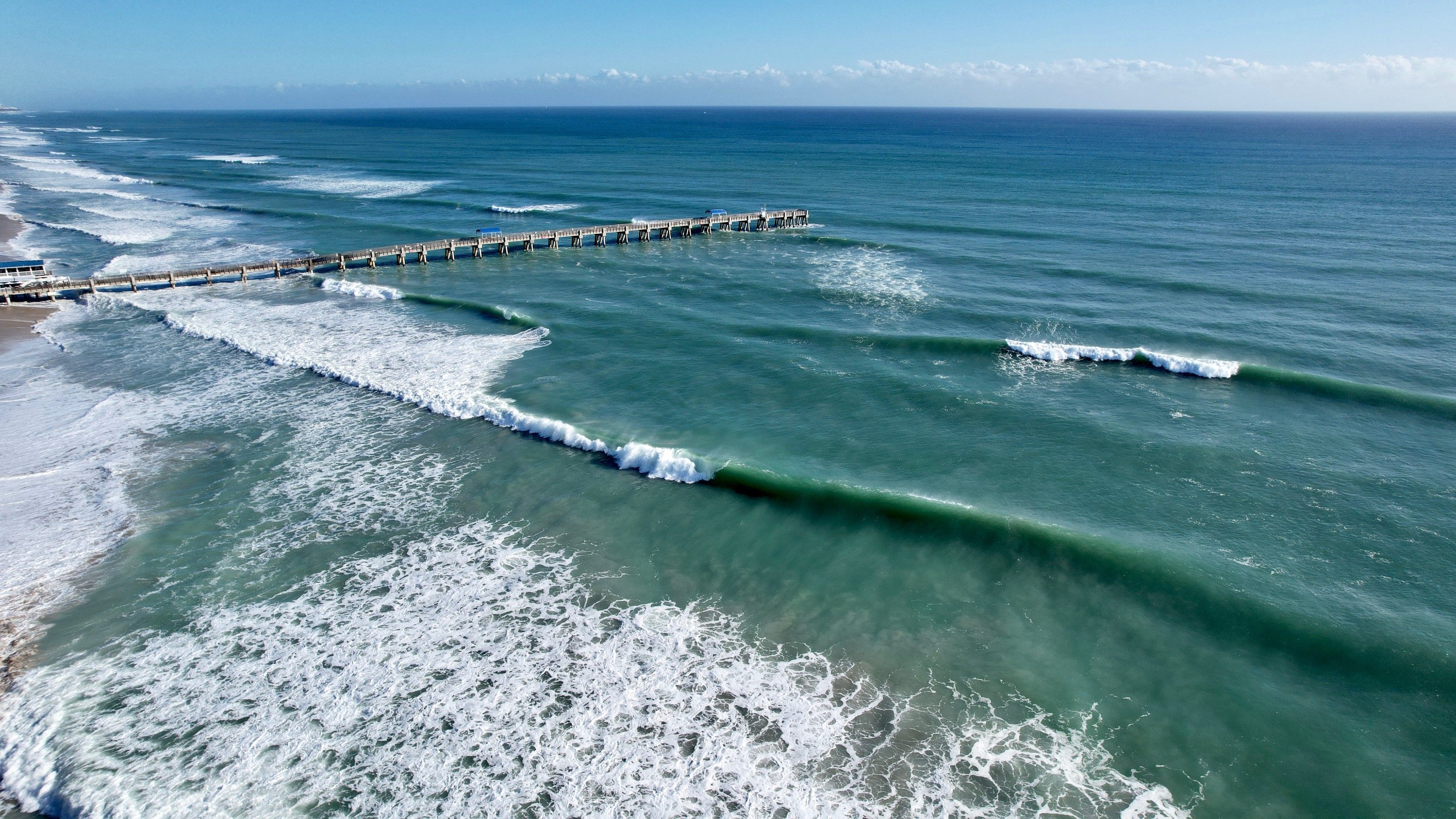
In the late '80s, the old Juno Beach Pier was destroyed by a powerful swell. Construction on the new pier began in the late '90s and sandbars have since formed on either side. Juno Pier is as consistent as the Lake Worth Pier to the south, and offers a similar setup. It's not a big-wave spot, but it can hold some size. Hurricane and nor'easter swells can send unruly, double-overhead lefts firing the length of the pier from the outside. At head-high, the waves are very lined-up and under control. There is a midsection that usually connects, and the inside is steep, fast and rippable. Fun windswell peaks throw over the inside, as well, with the better onshore nuggets found on the north side. Like most places in the Juno Beach and Jupiter area, the Pier breaks best during the incoming tide. Unlike most other spots in the area, it will still serve up a fun inside section at high tide if the swell is sufficient.Juno Beach Pier is the most consistent wave in north Palm Beach County and everyone knows it. Given the slightest trace of swell, something rideable will break off the south side of the pier, inviting the crowds, but there are a number of fun sandbars within a short hike of the pier.
Lake Worth Pier
Between the main cities of West Palm Beach and Fort Lauderdale are three smaller coastal communities, and each claim a surfing centerpiece that can be accessed off A1A. Lake Worth, which divides Palm Beach and South Palm Beach, has a pier of questionable reputation. Lantana is a couple miles south of Lake Worth on the west side of the Intracoastal Waterway, but also boasts a popular public beach. Boynton Beach, which has its own inlet and park, sits farther south between Manalapan and Delray Beach. Watch out for underwater rocks along the shore.When the sandbars are established, this pier provides the most consistent surf in South Florida. It's inside Lake Worth Municipal Beach off A1A, with plenty of metered parking for $1/hour. Don't mess around; these babies are really enforced.Lake Worth was once one of the most viciously localized break in Florida, which is probably why it's barely known beyond state lines. During the '70s and '80s, visiting surfers would encounter nightmarish ultra-violence of the "harass your girlfriend," "break your board" and "smash your windshield" variety. Once, after being dropped in on, a local followed his provocateur to the beach and proceeded to smash the surfer's board on a parking meter. The upset visitor took a swing at the local, but quickly found himself hog-tied around the very parking meter that took out his surfboard and was later found and untied by the police. Things have mellowed quite a bit since then.Clearly, Lake Worth must house a good wave to justify such extreme measures; in fact, it offers several. First, just before the guarded area on the south side of the pier, a sandbar runs farther south in front of an old seawall called Blackwall. When north or northeast swells are running and the sand is settled, fast, hollow waves reel along this bar, earning it the hyperbolic name, Banzai.The Pier's south side maintains an outside sandbar as well. Overhead swells will break off the end of the pier, mush out and then reform down by Blackwall. On the biggest swells, it gets steep and fast and occasionally connects all the way through to the inside. The south side is one of the better spots during nor'easter conditions -- if there isn't too much underlying groundswell -- as the waves are shielded somewhat from the wind.While north swells can sometimes bypass Palm Beach and be bigger in Lake Worth, the pier gets juiciest during east/southeast windswells. Sandbars off Blackwall will throw good rights under these conditions. However, if Northside is working, it's arguably the best peak on either side of the pilings, throwing hollow, high-speed, top-to-bottom rights. Some of the waves break left through the pier, and if you like to tempt fate and arouse the ire of authorities, shooting the pier is a good way to do both. This once highly highly localized spot is a bit tamer. Go to spot on windswells and can be some fun chunky wedges even if the wind is onshore. NE swells can get big here with basically no continental shelf thanks to its position close to the Florida Current. This spot can handle any size thrown at it and have seen faces 20'+ on the biggest swells. When it gets big, grab a bigger board and be ready to paddle.

South Beach Miami
South Beach has the potential to deliver barreling, board-breaking peaks. During north or northeast swell conditions, the A-frames are shapeliest on the incoming tide with offshore (west to northwest) winds. And while it is known through most of the year as a spot that hardly ever works, South Beach can be the only spot breaking statewide when zero-degree north swells bypass the rest of the Florida coast.

If you come here with reasonable expectations, an open mind and proper equipment, you can have a ton of fun.

When to Score & Seasonal Surf Data
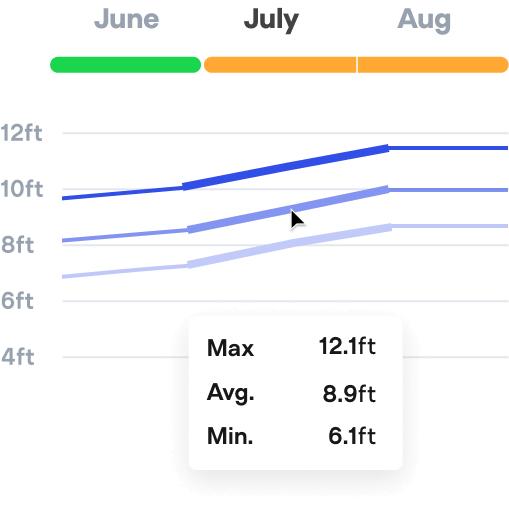
Know exactly when to score — powered by our expert historical forecast data.
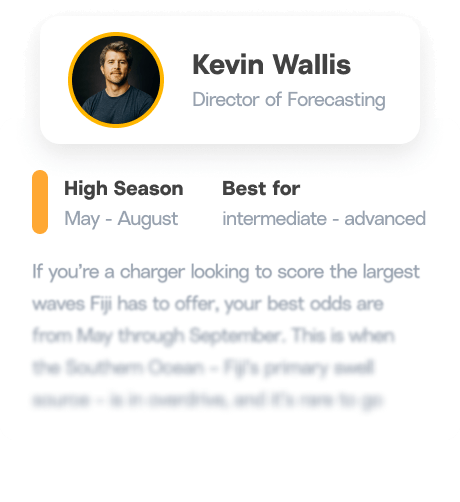
Decades of spot-specific swell info — combined with forecaster insights — show your best chance to score, found only on Surfline.
Time to score

Forecaster reports
Seasonal Surf Data

Florida, According to...
Dick
"Mez"
Meseroll
Legendary photographer/Eastern Surf Magazine co-founder casts a light on the Sunshine State
What makes Florida a special destination for surfers?
Florida has the longest coastline of the lower 48 states, approximately 1,350 miles of shoreline with a ton of quality beachbreaks — from the crunchy shorepound barrels of Fernandina Beach at its northernmost border all the way down to the unicorn of all Right Coast sandbar setups: South Beach, Miami. But there are so many other options to explore. If you come here with reasonable expectations, an open mind and proper equipment, you can have a ton of fun. The temperate weather is just a plus.
What kind of waves can visiting surfers expect?
Don’t come here for crazy slabs or XXL endeavors or even pointbreaks; although, some of our rivermouths like Monster Hole and Reef Road and a few other esoteric spots kinda mimic a pointbreak when their sandbars are groomed right. And contrary to what a lot of ill-informed people think, Florida does get legit, thumping, board-snapping barrels, especially along the east side of the peninsula. And concerning Florida’s Gulf Coast, well, the past few winters have been a real eye-opener to the potential there, particularly west of the Big Bend.
What’s the vibe?
I’ve traveled around the peninsula extensively for over 50 years and I find most surfbreaks and surf towns here to be chill, welcoming and unique. Surfers who call Florida home — including a Jersey transplant like me — tend to travel quite a bit out of state and out of country. They know what it’s like to roll up to a break they’ve never been to before, and how to blend in. So when they encounter the same scene at their homebreaks, as long as you don’t show up with a carload of people and act like a bunch of idiots, you will be just fine. And you’ll probably make some friends. Southern hospitality is still very strong in the Sunshine State, as long as you show respect to the locals, wait your turn, and maybe even give away a wave or two at the more crowded spots.
What should surfers bring?
Sunscreen. Do not underestimate the strength of the Florida sun, any time of the year. Sun poisoning. Second-degree sunburn. Blisters that fester and pop. And you can’t even take a hot shower afterwards, it’s just too painful. Every year, especially in the fall and winter months, I’ll watch visitors from colder climates come down here with their East Coast Ghost, lily-white skin and get positively scorched, and that just ruins the rest of their time here.
When is the best time to score?
Like most East Coast states, just about year-round, apart from the summer. That’s flat spell season in Florida. We’ll go weeks with next to nothing, which is why fishing and world travel is such a huge part of Florida surfers’ summer repertoire. For waves of substance and strength, though, there are two key times for scoring: hurricane season and winter.
What else is there to do when you’re not surfing?
Being a subtropical place, and a relatively narrow peninsula, Florida has two coasts surrounded by an ocean and a gulf, so everything watersports-oriented is in play and utilized. If you want to party, Spring Break offers a transitional, winter-to-spring, wave-generating weather setup, so that can be a great time to catch surf. If you really want to go ham, visit Disney World in Orlando and surf one of the world’s original wave pools, Typhoon Lagoon. Or go to Daytona Beach for stock car racing and Bike Week, the world’s biggest motorcycle gathering. Or go to Miami Beach for Fashion Week. Just bring your board, because all these destinations have waves.
What’s your favorite local cuisine?
Around here it’s Sunny Side Cafe in my hometown of Melbourne Beach for brekkie; then Da Kine Diego’s in Satellite Beach for burritos and bowls; in Indialantic it’s Long Doggers for surfer-inspired pub grub and the most excellent hot dogs and Thai Thai II for sushi; and this is kind of a well-kept secret but the Sebastian Inlet snack bar has breakfast burritos and a super tasty lunch menu. You can take your food up to the expansive second-floor deck, too, and watch all the action going down at Monster Hole, First Peak and Larry’s Lefts. They also serve cold beer for that post-arvo session where you can once again take it all in, the lineup and the sunset.
Where can people learn to surf?
As you would expect, there are a ton of independent and surf shop-oriented surf schools everywhere in Florida. On smaller days, of which there are many, pretty much everywhere has a spot for newbies to give it a go. Here in Brevard County, Cocoa Beach would be a great spot to start surfing. Former World Tour pro surfer and East Coast Surfing Hall of Famer Todd Holland teaches there, and who wouldn’t want to learn from this guy?
What are some things people should be aware of when it comes to local culture and customs?
Even with so many northern transplants like me, Southern hospitality still runs through this culture’s veins like sweet tea. Just show up with a good attitude and mind your manners in and out of the water.
Any other local tips?
Watch out for sharks of all kinds and sizes. They are here in large numbers, so you have to reconcile that whenever you paddle out they’re going to be there, so keep a third eye open, your head on a swivel, and watch out for your buddies who’re surfing with you. Also, Florida is the lightning strike capital of the world in terms of density (112.6 lightning events per square kilometer). Seriously deadly systems can pop up quickly and take you by surprise. The rule of thumb is if you see a thunderhead forming within a 20-mile radius and you start seeing strikes nearby, get the holy fuck out of the water and run for cover.
Travel Essentials
Culture & customs
Floridians are generally adventurous (water, water everywhere), hospitable (Bible Belt) and mellow (Caribbean proximity), but don’t be fooled by the irie vibes and parrothead slackness. The Floridan surfer is defined by a surf-starved existence that requires constant attention and instantaneous reaction to every bump that dares to raise its wet, foamy little head. Resourcefulness, optimism, and creativity is encoded into the Florida surfer’s DNA right along with their penchant for gimmicks, lust for life and lofty performance standards. The average surfer in Florida rips ten times harder than the average surfer at your beach, so their waves can’t be all that bad.
Local scene
Florida surf culture dates back to the early 1930s in Miami Beach, when a few Virginian visitors impressed local bodysurfers Dudley and Bill Whitman, Gaulden Reed and Paul Hart with their standup skills, inspiring the boys to build their own wooden surfboards. In 1933 Tom Blake bequeathed his hollow board technique to the Whitmans, then in 1939 Daytona Beach hosted the East Coast’s first contest, effectively making it Florida’s first surf town. Dudley started selling boards out of his house in Daytona before opening Florida’s first surf shop in 1961, and Sunshine State surfing was off to the races. Today, Florida is the East’s premier surf industry hub that consistently churns out world-class surfers. Nevertheless, residents bear the dubious weight of prejudice and ridicule. There’s the Redneck Riviera thing and the Florida Man thing, but Floridians don’t really give a shit how others view them because they invented aerial surfing, hold 21 World Titles, put 15 people on the World Tour and drop freesurfing freaks like coconuts, so suck it.
What to bring
No matter what design you prefer, bring something fat, wide, and most importantly, buoyant. Epoxy works wonders down here. You wanna have a fish, a mid-length, or a longboard on hand at all times because most Florida beachbreaks are fast down the line but slow to the beach. But bring your lightest, most responsive shortboard, too, in case you score an actual swell or you’re striking somewhere that pitches, like an Inlet wedge or a North Florida dredge. And if you’re striking a super rare bird like Pumphouse or maxing RC’s, a step-up wouldn’t be a bad idea.
How to get there
Fly into Orlando, rent a vehicle, and go directly to New Smyrna Inlet, the most consistent surf spot in the whole state, about an hour away, and begin your trip on a wet note. From there, the forecast will dictate your movements.
Downtime
This is basically Waterworld, so that’s where you’ll spend every waking moment. Watersports, waterparks, water tours, boating, fishing, swimming, diving. If you want concrete, go to New York City.
Quick Tips
Travel Time
LAX: 4 hours, 40 minutes
Heathrow: 10 hours
SYD: 19 hours
Connectivity
Cell phone connectivity in Florida is generally reliable across the state, including in cities and rural areas, and Florida ranks well among states for internet availability and speed.
Currency
U.S. Dollar.
Avg. cost of...
Cup of coffee: $3.00 USD
Lunch: $17.50 USD
Beer: $6.50 USD
Hotel room: $211 USD
Visa Requirements
Visitors may require a visa, depending on their nationality and/or the purpose of their trip.
Drinking water quality
It’s been ranked as the second worst in the United States; however, the EPA says Florida’s tap water does meet federal drinking water standards.
Hazards
Florida in general and New Smyrna Beach in particular is the Shark Bite Capital of the World, although most “attacks” are a case of mistaken identity. The only thing more violent is the weather: hurricanes, tornados, lightning… And if the armies of buzzing, biting or stinging insects don’t bum you out, the sweltering heat and humidity will. Then you got your sea lice, your wayward gators and the occasional bout of red tide.
Cash, card, crypto
This is America, the world’s largest economy, so money talks. Most businesses accept major credit cards, some probably even take crypto. U.S. dollars are still a thing, too, and you’re never too far from an ATM.
Best first surf trips.


Have feedback on this zone? Let us know [email protected]
Questions about booking with Surfline Travel? Check out our FAQs