|
SAFFIR-SIMPSON HURRICANE INTENSITY
SCALE
|
|
 |
| Mph |
| 74-95 |
| 96-110 |
| 111-130 |
| 131-155 |
| 156+ |
|
|
| min.
surface pressure |
| 980+ millibars |
| 979-965
mb |
| 964-945
mb |
| 944-920
mb |
| less than
920 mb |
|
|
| storm
surge |
| 3-5' |
| 6-8' |
| 9-12' |
| 13-18' |
| 19'+ |
|
|
| damage |
| minimal |
| moderate |
| extensive |
| extreme |
| catastrophic |
|
Prerequisites of a tropical
cyclone:
warm ocean - 80+ degrees down to 150'
deep
moist, unstable atmosphere - favorable
for convection and thunderstorms
300+ miles from the equator - Coriolis
force needed to maintain pressure
Pre-existing disturbance - tropical
cyclones never occur spontaneously
Low wind shear - changes in wind speed
with height will prevent formation
|
TALE OF THE TAPE -- AN EAST-WEST
COMPARISON
|
Atlantic/Caribbean |
|
Eastern Pacific |
| Season |
june 1- november
30 |
|
may 15- November
30 |
| Strongest |
Camille (69),
Allen (80) - 190 mph+ |
|
Tip (79), Nancy
(61) - 190+ |
| Longest |
Ginger (71) -
28 days |
|
John (94) - 31
days |
| Most in a yr. |
12 |
|
14 |
| Least |
2 |
|
4 |
| Average |
5.4 |
|
8.9 |
Deadliest - Bangladesh Cyclone
on 1970 - at least 300,000 killed; In U.S. - Galveston
Hurricane of 1900 - over 8000 deaths
Costliest - Andrew (92) - $38.3 billion
in southeast; Figuring for inflation - Great Miami
Hurricane of 1926 - $83 billion+
Why don't West Coast storms
make landfall while the East gets battered every
year?
Hurricanes are steered by weather patterns in
a general west/northwest direction after forming
in the tropics. In the Pacific, this course takes
a hurricane out to sea, while in the Atlantic
it has its choice of several states. A large reason
for this trend is the Gulf Stream, a northbound
current drawing warm water up the East Coast.
On the other hand, California water temperatures
rarely rise above the low 70's, greatly reducing
the strength of any approaching tropical cyclone.
FAVORITE SURFING SEASONS:
EAST COAST: 1995's record of 19 named storms is
not only the most recent favorite, it's the second
most active Atlantic season since they began keeping
records over 100 years ago. 11 of the storms reached
hurricane strength, but none were so appreciated
as Felix, which spun for 12 days, stroking the
whole coast from Maine to Miami with epic surf.
It's doubtful East Coasters will see another like
'95, but this season is more responsible than
any for fueling the regions carnal lust for tropical
activity.
WEST COAST: Unfortunately, West
Coast surfers don't harbor the same religous zeal
for hurricanes since tropical swells are rarely
as substantial as the winter norths or even a
really solid southern hemi. But the combo of Guillermo
and Linda in 1997 was enough to widen expectations
for what a tropical season can really do. Nearly
500 miles across, Guillermo raged for 21 days
in August, sending more than a weeks' worth of
surf to almost all of California. Come September,
Linda followed suit, moving north far enough to
almost hand-deliver the swell, resulting in a
rare hurricane warning for Southern California.
(In 1939, the remnants of a hurricane actually
impacted California, causing tremendous floods
and tearing out coastal homes and piers.)
GULF COAST: Most summers, the Gulf
Coast crew vainly hopes for just one or two tropical
swells to spare them from the season of flatness
while the Atlantic Seaboard reaps most of the
rewards. But in 1998, these surfers were rewarded
for their patience when five of the six named
storms that entered the Gulf sent more surf than
they did damage. Charlie, Earl, Frances, Georges,
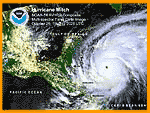
and Mitch had surfers grinning from South Padre
to Tampa, reversing the normal seasonal pattern
of migration as East Coasters struck turned west
to strike gold on the Panhandle.
HAWAII: It's hard to say if Hawaii's
ever had a favorite season. Like California, hurricanes
just don't get the job done in the islands compared
to winter's overflowing bounty. But if you're
looking for the most memorable year, it would
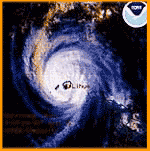
have to be 1992 when Hurricane Iniki plowed through,
causing $2.2 billion in damages. It was only the
third storm to directly impact the islands in
fifty years, and it's one they won't soon forget.
|